
AI Hijacks CES 2026
3 mins.
Welcome back, and happy new year!
Sometimes I wonder what the world will look like 20 years from now.
The tech leap boomers imagined millennials would face was big, but the leap we’re imagining for the kids who’ll be entering early adulthood two decades from today feels almost impossible to grasp.
It’s like comparing Mario to Galactus.
For this week, though, the future is already on display: the Consumer Electronics Show (CES) 2026 officially opens today, and just about everything on the show floor seems to be promising some form of AI.
Let’s dive in.
On deck:
◾ AI hijacks CES 2026
◾ OpenAI bets on Voice
◾ Artisan.co Vs Outbond.ai
◾ One-Page Offer Stack
◾ 10 other AI news updates worth your attention
📡Signal behind the buzz🔊
Decoding trending AI stories.
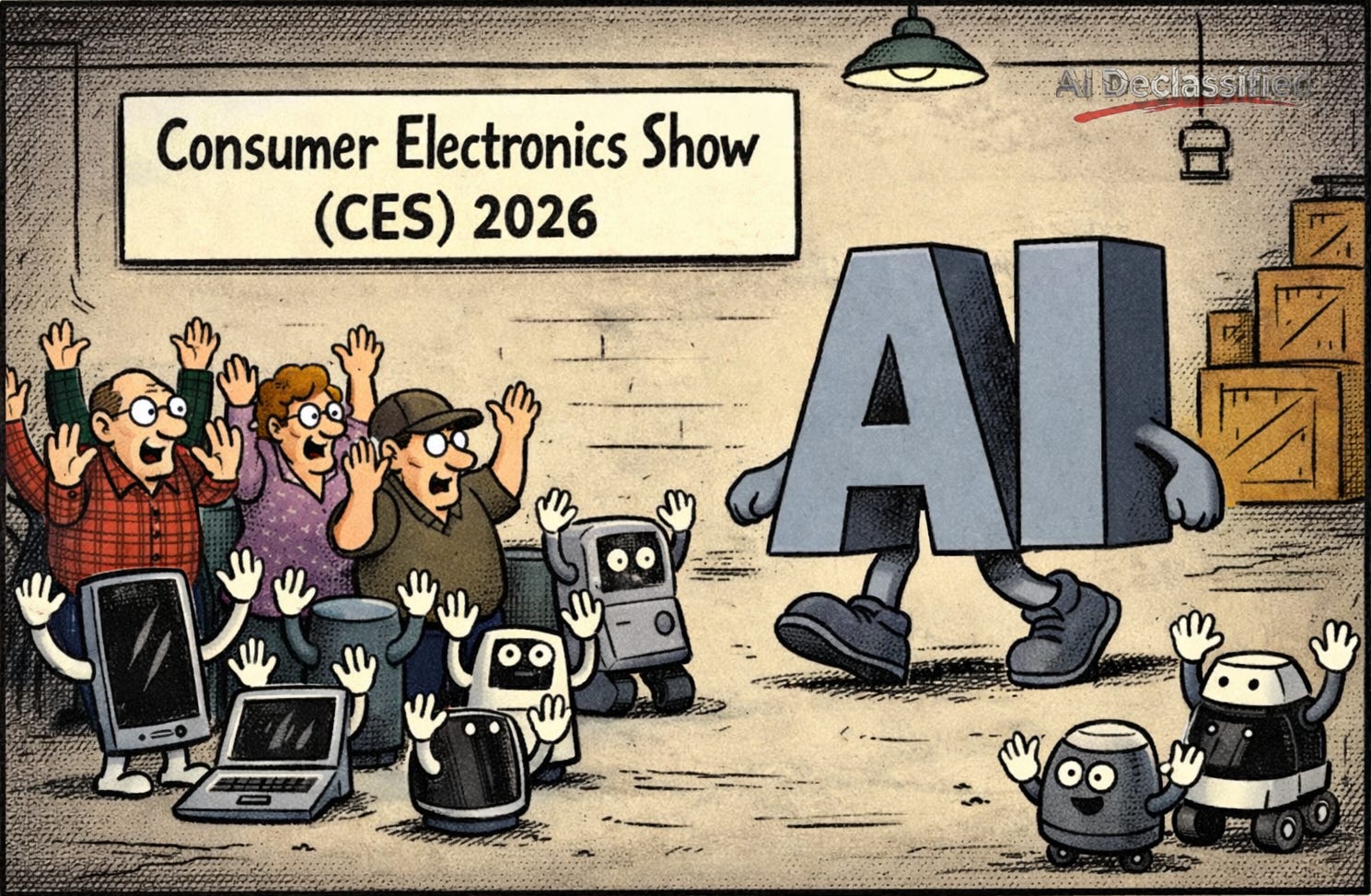
📍AI hijacks CES 2026
🔊Buzz:
CES 2026 looks less like a gadget show and more like an AI festival. NVIDIA and Intel are taking center stage, while demo clips across the floor promise a future where everything, from laptops to earbuds, is “AI-powered.”
📡Signal:
“AI” at CES often means one of three things:
Tiny models running on-device (fast, private, but limited by hardware).
Cloud AI behind an app (powerful, but usually tied to a subscription and an internet connection).
Basic automation rebranded with a buzzword.
🎯Impact:
Don’t ask “Does it have AI?” Ask: What specific task does it do better than last year, and where does my data go?
The winners won’t be consumer electronics with the flashiest demos, they’ll be products that work reliably in messy real life, without surprise paywalls, battery drain, or privacy tradeoffs.
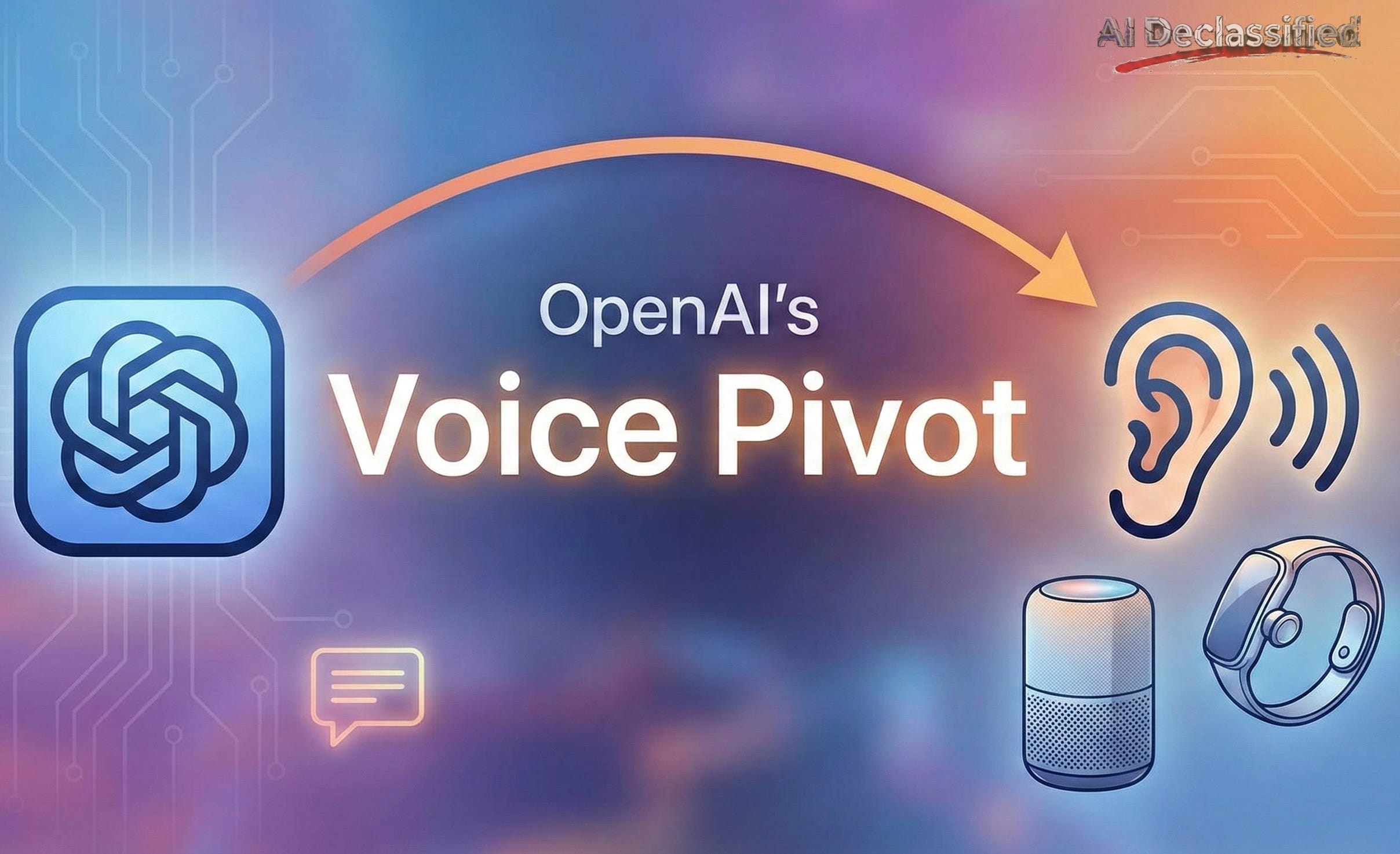
📍OpenAI bets on Voice
🔊Buzz:
Reports say OpenAI is reorganizing teams around audio, aiming for a new voice model in early 2026 and, longer-term, an audio-first consumer device (possibly something screenless like a smart speaker or wearable).
📡Signal:
“Voice” is harder than it seems. Real conversation involves timing, interruptions, background noise, emotion, and speaking over each other without confusion.
That requires fast “real-time” models, tight latency, and careful safety rules, because a persuasive voice can feel more trustworthy than it deserves.
Hardware matters here, too: whoever controls the microphone, the wake word, and the processing, controls the whole experience (and the data).
🎯Impact:
The practical payoff is hands-free help in motion: quick questions, navigation, summaries, and small tasks without pulling out a screen.
But “companion” framing should trigger your privacy instincts. Before you buy in, look for clear answers on data retention and on-device processing. Also remember that these models, sometimes, can be confidently wrong.
Tool Spotlight🔦
Your guide to choosing the right tools with confidence.

Introduction:
The modern outbound landscape has shifted from manual "spray and pray" to automated, high-intent systems that behave like digital employees.
For teams deciding between Outbond.ai and Artisan.co, the choice boils down to whether you want a flexible toolkit to build your own playbooks, or a fully autonomous "AI BDR*" that runs the entire show for you.
(*BDR = Business Development Representative)
Platform comparison:

Verdict:
Choose Outbond.ai if you are a lean team looking for an affordable, AI-assisted way to rapidly generate and export personalized sales playbooks.
Opt for Artisan.co if you have the budget to consolidate your entire outbound stack, from data to delivery, under one autonomous agent.
💡Workflow Lab
Practical AI ideas to work faster and smarter.
📍One-Page Offer Stack
What it is:
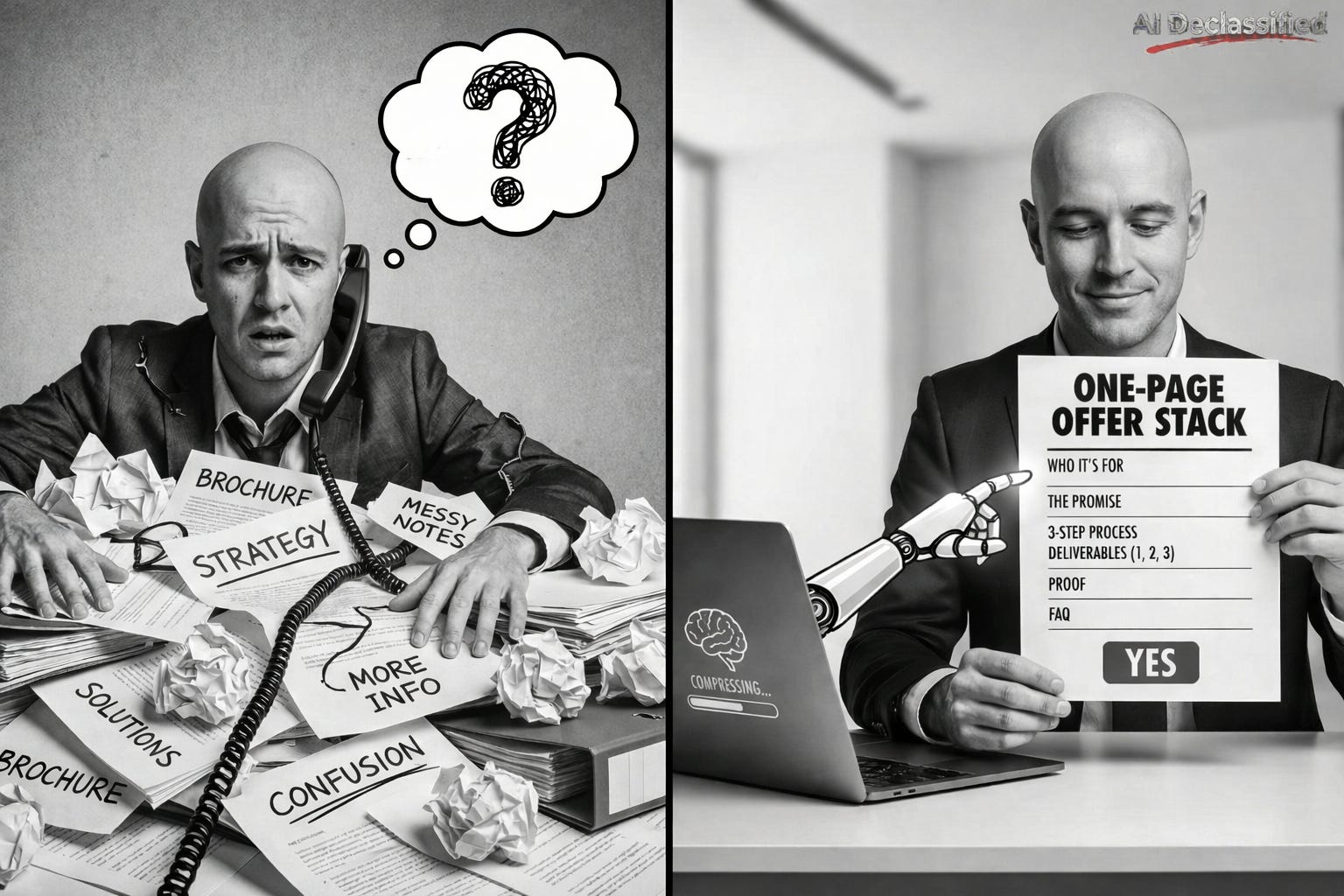
A One-Page Offer Stack is a single page that makes your service feel obvious to buy: who it’s for, what they get, how it works, why you’re credible, and what to do next.
The goal isn’t “more info.” It’s less confusion. AI helps you compress what you do into clear language that sells without sounding “sales-y.”
Real-world example:
Say you run a small consulting or creative agency and referrals have slowed. You know you’re good, but your website reads like a brochure: “strategy, design, solutions.”
You feed your messy notes, past client wins, and pricing into AI and ask it to draft a one-page offer that’s specific: a named package, a defined timeline, exact deliverables, and a simple decision path.
Suddenly prospects don’t need a call just to understand you, which is often where they drop off. They see the offer, they instantly get it, and they’re more likely to take the next step.
Use this prompt template:
Act as a direct-response strategist. Here’s my service, ideal client, past results, and current pricing: [paste]. Create a one-page offer with: a sharp headline, who it’s for/not for, the promise, 3–5 deliverables, process in 3 steps, proof points, FAQ that handles objections, and a clear call-to-action. Write it in plain English, confident but not hype. Give me 2 versions: premium and mid-tier.
🍵AI News Quick Hits
🧠 NVIDIA unveiled its “Rubin” data-center platform at CES (six chips that act like one system), promising cheaper AI answers; partner hardware ships in the second half of 2026.
🦿 Boston Dynamics and Google DeepMind are teaming up to bring Gemini Robotics “brains” to Atlas, basically, teaching a humanoid to pick up new skills faster with foundation models.
🤖 NVIDIA also released new “physical AI” building blocks (Cosmos + GR00T models) at CES to help robots learn in simulation and real life, aimed at speeding up general-purpose robotics.
📺 Google previewed Gemini on Google TV, so you can ask for recommendations, summaries, and kid-safe answers, and even fix settings by voice (“too dim,” “can’t hear dialogue”).
🎙️ OpenAI is reportedly reshuffling teams to ship a more natural voice model in early 2026, and is exploring audio-first devices about a year later (think “talk to it,” instead of “tap it”).
📜 California’s SB 53 AI transparency law took effect Jan 1, pushing big “frontier” model builders to publish safety/risk frameworks and disclosures, like a public owner’s manual for powerful AI.
⚖️ U.S. courts are heading into a pivotal year on AI training and copyright: judges are split on “fair use,” and the outcomes could reshape how models get built (or paid for).
🚨 Britain demanded answers after Grok generated non-consensual “undressing” images and sexualized content involving children; regulator Ofcom is probing X/xAI’s online-safety compliance.
💹 China’s MiniMax is set to price its Hong Kong IPO at the top of the range (about a $538M raise), signaling investor hunger for multimodal AI startups despite geopolitics.
📈 China AI chipmaker, Biren, jumped about 76% in its Hong Kong debut after raising roughly $717M, kicking off 2026 with “AI chips” as the hottest listing theme.
What do you think of this week’s newsletter? Hit reply and let me know.
See you next week!